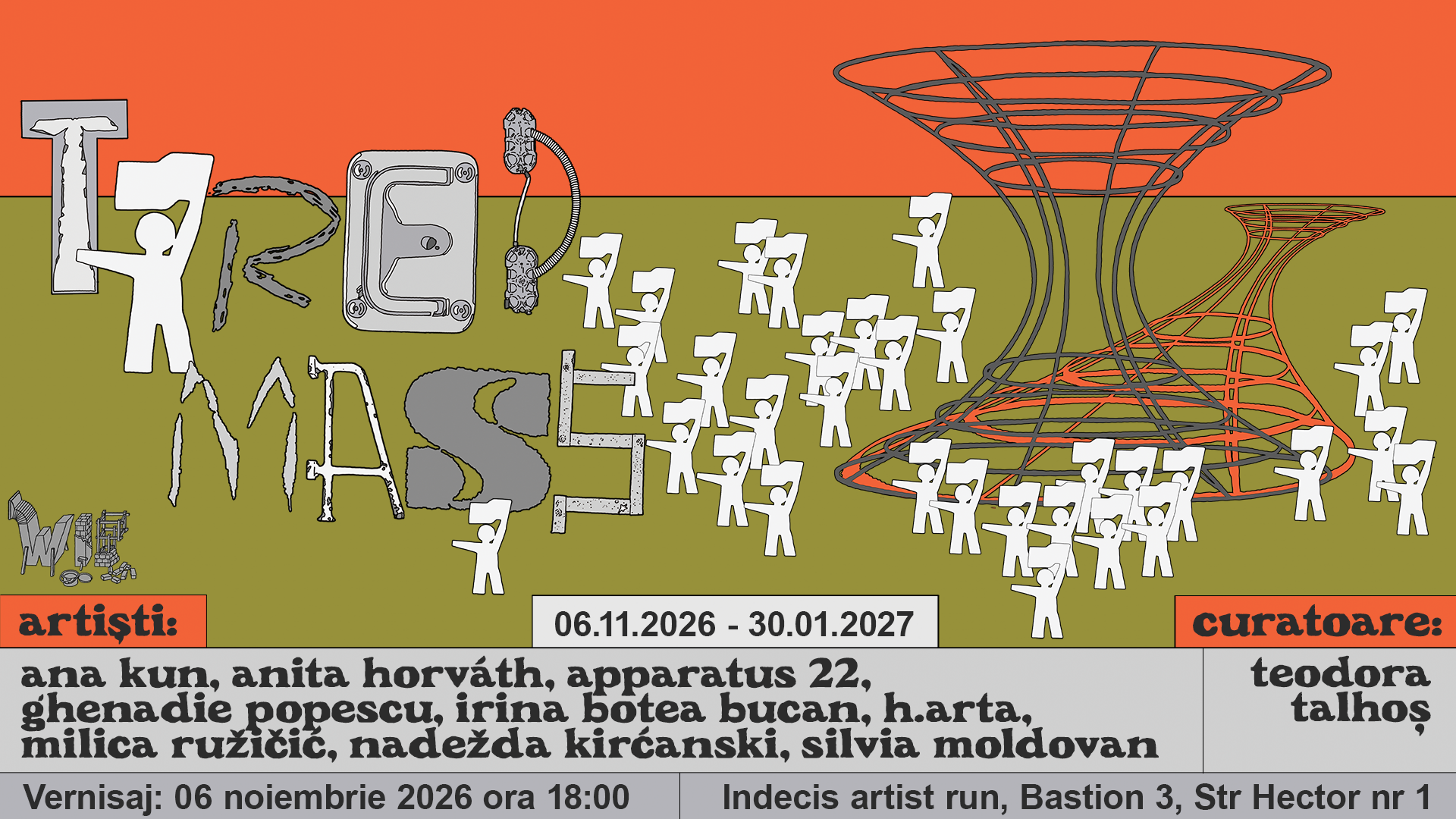
November 6, 2026 — January 30, 2027
Opening: Friday, November 6, 18:00
Exhaustion is often presented as an individual problem. Sleep more. Manage your time better. Take a break. Learn to say no. There is always another app, supplement, retreat or routine promising to restore the body just enough for it to carry on.
But what if exhaustion is not simply the result of how we manage our time? What if it is also produced by insecure work, the rising cost of living, political instability, an endless stream of information, and the expectation that we remain available and productive regardless of what is happening around us?
Curated by Teodora Talhoș, the group exhibition Tired Mass begins with an exhaustion that may be widely shared, but is anything but evenly distributed. It considers exhaustion less as a personal failing than as a symptom of the conditions under which people live and work, with particular attention to Eastern Europe and to those who have the least access to stable forms of protection and support.
One of the questions running through the exhibition is what happens when even sleep becomes subject to the same logic. We monitor it, optimise it, turn it into data and try to make it more efficient, while the wellness industry sells increasingly elaborate solutions to bodies worn down by the pace of everyday life. At the far end of this logic lies the fantasy of a body that no longer needs to stop: permanently present, permanently available, permanently productive. New technologies and the promise of automation have not made that fantasy disappear. They have given it another form.
The works in Tired Mass trace different ways in which these pressures enter bodies, work and everyday life. Ana Kun, Anita Horváth, Apparatus 22, Ghenadie Popescu, Irina Botea Bucan, h.arta, Milica Ružičić, Nadežda Kirćansk and Silvia Moldovan approach social, economic, political and ecological forms of exhaustion from different positions and contexts. They are joined by contributions from guests working outside the arts in Timișoara and by processes developed through The Shape of Work.
The title does not propose tiredness as a new collective identity, nor does it turn exhaustion into a comforting image of solidarity. The mass in Tired Mass is uneven. We do not become tired for the same reasons. We do not have the same resources that allow us to stop, or the same freedom to refuse the pace that exhausts us.
Perhaps the question is not simply how can we rest better? Perhaps it is also: why does it take so much recovery just to continue in the same way?
PUBLIC PROGRAMME
While the exhibition is open, a programme of encounters and activities will develop around three forms of work that most of us perform, even when we do not necessarily name them as work: physical, intellectual and emotional labour.
Rather than beginning by explaining the works in the exhibition, the programme starts from experiences visitors already know: the tiredness at the end of a working day, attention beginning to run out, caring for other people, making things with our hands, and the time it takes to recover.
These three strands are not meant to divide work into neat categories. They offer ways of noticing how often these forms overlap: how much attention a physical task requires, how much emotional labour an ordinary day can contain, and how much work is involved in producing knowledge.
Developed together with local educational partners, the programme will include activities for school pupils, students and people with disabilities, alongside materials and mediation formats conceived with different access needs in mind.